DiSC Personality Assessment (Online 24 items)
The above is a sample of the complete report version.
Purchase information:
1. This assessment is conducted entirely online.
2. Your order will be confirmed automatically upon payment, and you will immediately receive an email containing the link to the online assessment.
3. After accessing the link and answering all the questions, re-enter it to view the full report.
4. For logged-in users: Your order details will include the online assessment link. You will also receive an order confirmation email containing the assessment link to the registered email address you provided.
5. For non-logged-in users: Please ensure you record the link to the online assessment provided in the order details.
The DiSC (Dominance, Influence, Steadiness, Compliance) Personality Assessment is a widely used behavioral tool designed to measure an individual’s personality traits and behavioral preferences in various contexts, particularly in workplace settings. Rooted in the theories of American psychologist Dr. William Moulton Marston (1928), who focused on normal human behavior rather than pathology, the DiSC model aims to explain how people respond to challenges, interact with others, and approach tasks. Unlike personality tests that label individuals into fixed types, DiSC emphasizes behavioral tendencies—it describes howpeople act, not whothey are—and recognizes that everyone possesses a unique blend of the four dimensions.
1. Theoretical Foundation: The Four Dimensions of Behavior
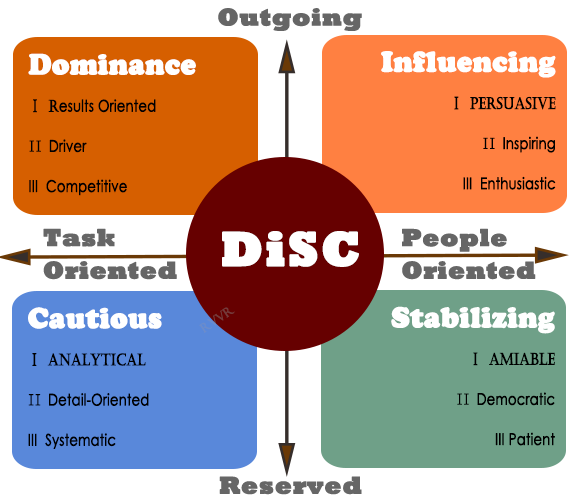
The DiSC model is built on four core behavioral dimensions, each representing a distinct pattern of response to environmental stimuli. These dimensions are not mutually exclusive; instead, they combine to form an individual’s unique behavioral profile:
- Dominance (D): Individuals high in Dominance are decisive, results-oriented, competitive, and direct. They prefer control and immediate action, with core motivations centered on achieving goals, overcoming obstacles, and taking charge. Under pressure, they may become high-handed or overly focused on outcomes, but their drive makes them effective at initiating change and solving problems.
- Influence (I): Those with high Influence are outgoing, enthusiastic, persuasive, and optimistic. They thrive on social interaction and collaboration, motivated by building relationships, inspiring others, and having fun. In stressful situations, they may become overly talkative or unrealistic, but their charisma helps them motivate teams and build consensus.
- Steadiness (S): High Steadiness individuals are patient, reliable, supportive, and calm. They value stability, harmony, and cooperation, with motivations rooted in maintaining consistency, helping others, and avoiding conflict. When stressed, they may withdraw or resist change, but their loyalty and patience make them dependable team players.
- Compliance (C): People high in Compliance are analytical, detail-oriented, rule-abiding, and objective. They prioritize accuracy and logic, motivated by ensuring quality, following procedures, and making informed decisions. Under pressure, they may become overly critical or indecisive, but their attention to detail makes them valuable for tasks requiring precision and thoroughness.
Developed from Marston’s 1928 book Emotions of Normal People, the DiSC model was initially used to study normal human emotions but has since evolved into a practical tool for understanding workplace behavior. Unlike Freudian or Jungian theories, which focus on unconscious processes, DiSC centers on observable behavior—making it highly applicable to real-world settings like business and education.
3. Key Features: Behavioral Focus and Flexibility
The DiSC assessment stands out for its practical, action-oriented approach to personality. Unlike tools that measure cognitive preferences (e.g., MBTI), DiSC focuses on what people do—not how they think. This makes it particularly useful for:
- Workplace Applications: Team building, leadership development, conflict resolution, and sales training. For example, a “High D” manager might learn to delegate more effectively, while a “High C” employee might improve their communication with “High I” colleagues.
- Personal Growth: Helping individuals understand their behavioral blind spots (e.g., a “High I” person recognizing they need to follow through on tasks).
- Cross-Cultural Relevance: The DiSC model is widely used in 84 countries and is not tied to specific cultures or languages, making it adaptable to diverse populations.
Another key feature is its non-judgmental nature: DiSC does not label traits as “good” or “bad.” Instead, it highlights how different styles can complement each other—for instance, a “High D” leader might pair well with a “High S” assistant who balances their impulsivity with patience.
4. Applications in Workplace and Beyond
The DiSC assessment is most commonly used in organizational settings, where understanding behavioral differences is critical to success. Key applications include:
a. Team Building
By mapping team members’ DiSC profiles, leaders can identify complementary skills (e.g., pairing a “High I” salesperson with a “High C” analyst) and reduce conflict (e.g., helping a “High D” member understand a “High S” member’s need for stability). This improves collaboration and leverages each member’s strengths.
b. Leadership Development
Leaders can use DiSC to adapt their management style to different team members. For example, a “High D” leader might need to listen more to “High S” employees, while an “High I” leader might need to set clearer goals to improve execution. This adaptability enhances employee satisfaction and performance.
c. Sales and Customer Service
Salespeople can use DiSC to tailor their pitch to different customer styles—using data with “High C” clients and storytelling with “High I” clients. This builds rapport faster and increases成交效率 (conversion rates).
d. Recruitment and Selection
DiSC helps organizations match candidates to roles based on behavioral fit. For example, a “High D” candidate might excel in a sales role, while a “High C” candidate might be better suited for a quality assurance position. This reduces turnover and improves job satisfaction.
5. Differences from Other Personality Tests (e.g., MBTI)
While DiSC is often compared to other personality assessments like the Myers-Briggs Type Indicator (MBTI), the two tools serve different purposes:
- Focus: DiSC measures observable behavior(what people do), while MBTI measures cognitive preferences(how people think).
- Structure: DiSC uses four continuous dimensions (blended profiles), whereas MBTI uses four dichotomies (16 fixed types).
- Application: DiSC is more practical and workplace-focused, while MBTI is more introspective and personal growth-focused.
For example, a person might have an MBTI type of “ENTJ” (extraverted, intuitive, thinking, judging) but a DiSC profile of “High D, High I” (decisive and outgoing). The MBTI describes their cognitive style, while DiSC describes their behavioral tendenciesin a given situation.
6. Criticisms and Limitations
Despite its popularity, the DiSC assessment has faced some criticisms:
- Oversimplification: Reducing complex personalities to four dimensions may overlook nuances (e.g., a “High C” person who is also creative).
- Self-Report Bias: Like all self-assessments, DiSC relies on honest responses—users may over- or understate traits to fit social expectations.
- Limited Predictive Power: While DiSC provides insights into behavior, it does not predict job performance or long-term success on its own.
However, proponents argue that these limitations are offset by DiSC’s practicality and ease of use. When combined with other tools (e.g., interviews, performance reviews), DiSC can be a valuable part of a comprehensive assessment strategy.
Conclusion
The DiSC personality assessment is a versatile tool for understanding behavioral differences in the workplace. By focusing on observable behavior rather than fixed traits, it helps individuals and teams communicate more effectively, resolve conflicts, and leverage their strengths. While it is not a substitute for deep psychological analysis, its practicality and adaptability have made it a staple in organizational development—used by millions of people worldwide to improve teamwork, leadership, and overall performance.