
A comparative analysis of European, American, and East Asian populations based on the NEO-FFI scaleThis study draws upon the seminal work of Costa and McCrae (1985), who published the NEO Personality Inventory (NEO-PI), followed by the NEO-FFI (Costa & McCrae, 1989). Saucier (1998) developed 13 subscales for the NEO-FFI, which demonstrated high alpha reliability. The objective of this study is to analyse the psychometric properties of the Big Five personality traits in East Asian and Western samples, with the aim of exploring the cultural contexts of the East and West in which the samples are situated. Given the length of the NEO-PI-R (240 items), which has been shown to result in unreliable sample precision (Jones, 2019), this study employed the NEO-FFI scale, which randomly includes “inconsistent response” items.
1. Subjects and Methods
1.1. Subjects
A total of 1,812 participants were included in the study, of whom 1,607 completed the questionnaire element of the study. The comparison group for the primary scale was comprised of the European and American Group A, while the comparison group for the subscales was comprised of the European and American Group B. Please refer to Table 1 for further details.

1.2 Methodology
The present study employed the NEO-FFI scale for the purpose of evaluating participants. In addition, a random selection of ten items was incorporated into the F scale with a view to ascertaining whether participants were responding in an arbitrary manner. This approach was adopted with a view to enhancing the accuracy of the valid questionnaires.
2 Results
The gender composition and educational levels of the sample groups were found to be similar; therefore, the following analysis does not account for significant differences in the participants’ understanding of the scale.
2.1 Comparison of the Main Scales
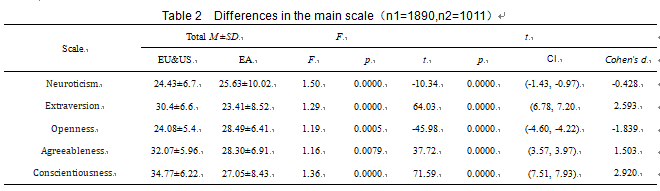
As illustrated in Table 2, a clear distinction emerges in the mean scores and standard deviations between the European and American samples, on the one hand, and the East Asian samples, on the other hand, on the primary scales.
2.2 Comparison of Main Scales Between East Asian Men and East Asian Women
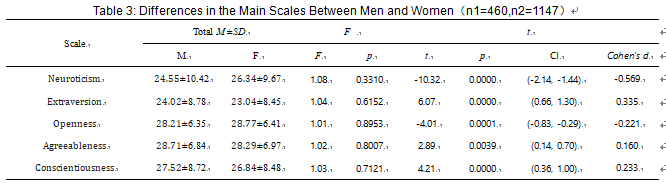
The mean scores and standard deviations on the main scales for the East Asian male and female samples are presented in Table 3.
2.3 Comparison of Subscale Scores
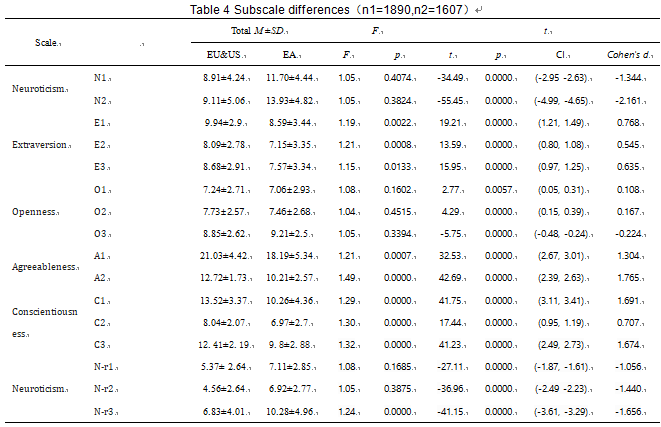
As illustrated in Table 4, a clear distinction emerges in the mean scores and standard deviations of the subscales between the European and American samples and the East Asian sample.
3. Conclusions/Discussion
The data demonstrate that, owing to discrepancies in social values and social environments between East Asian and Western populations, there are substantial discrepancies in the measurement results.
3.1 Primary Scales
3.1.1 Neuroticism
The Neuroticism scale is indicative of an individual’s emotional stability. Those who score highly on the scale tend to experience anxiety and depression, and their emotional fluctuations are more pronounced.
A significant difference was identified between the neuroticism scores of the Western sample and those of the East Asian sample, with a moderate effect size (d = -0.428). This finding suggests that Western populations may in fact demonstrate greater emotional stability, thus contradicting the commonly held belief that “East Asians are more emotionally reserved”. While this discrepancy does possess certain practical ramifications, its magnitude is constrained, and interpretations ought to be formulated with prudence.
The following factors may be relevant in this context:
(1) Cultural factors
Western cultures encourage individuals to actively express their emotions. In contrast, East Asian cultures place a greater emphasis on overall harmony.
Collective responsibility and societal norms are emphasised in East Asian cultures, while individualism and self-acceptance are encouraged in Western cultures.
(2) Social Environment
East Asian societies are currently experiencing intense levels of competition, resulting in significant pressure on individuals with regard to education and career opportunities. In contrast, Western societies tend to place a greater emphasis on individual feelings.
(3) Behavioral Patterns
East Asian cultures have been shown to exhibit tendencies towards external attribution, whereby stress is attributed to social and environmental factors. In contrast, Western cultures have been observed to demonstrate a propensity towards internal attribution, characterised by an emphasis on personal control.
East Asian cultures encourage individuals to suppress their emotions, whereas Western cultures encourage individuals to release their emotions in a timely manner.
3.1.2 Extraversion
The term ‘extraversion’ is defined as a personality trait which manifests in individuals who are highly sociable, enthusiastic, and proactive in their pursuit of stimulation.
A significant difference was observed in extraversion scores on the scale between the Western sample and the East Asian sample, with a large effect size (d = 2.593).
The following factors may be relevant in this context:
(1) Sociocultural factors
Western cultures tend to encourage self-expression, whereas East Asian cultures are characterised by a greater degree of reservedness and a stronger consideration of the opinions of others.
(2) Social Environment
East Asian social environments are characterised by an emphasis on discipline and adherence to traditional values. In contrast, Western societies are marked by an encouragement of active engagement with others and a tendency towards self-confidence.
In East Asia, an excessively outgoing disposition may be perceived as a deficiency in composure, whereas in the West, extroversion is commonly regarded as a favourable personality attribute.
(3) Behavioural Patterns
Lower levels of extraversion have been shown to be indicative of an individual’s tendency towards introspection as opposed to social interaction. This has the potential to influence the manner in which emotions are expressed and the individual’s ability to cope with stress.
3.1.3 Openness
The Openness scale is indicative of an individual’s receptiveness to new experiences, abstract thinking, and artistic appreciation. Those who achieve higher scores tend to demonstrate a greater inclination towards exploration and innovation.
Openness scores in Western samples were found to be significantly lower than those in East Asian samples, exhibiting a substantial effect size (d = -1.839). This outcome may contradict previous assumptions regarding cultural differences in openness.
The following factors may be implicated in this phenomenon:
(1) Cultural Factors
Whilst Western societies are known to encourage individualism and innovation, it is important to note that certain social groups may exhibit lower acceptance of new ideas (especially in the current, increasingly conservative social environment).
In recent years, East Asia has undergone rapid economic, technological, and cultural transformations, resulting in East Asians becoming more open-minded and better adapted to the ever-changing demands of society.
(2) Education and Cognitive Styles
In recent years, the East Asian educational system has undergone a shift towards a more diverse and open-minded approach, which may have contributed to higher openness scores among East Asians.
While Western cultures as a whole tend to promote open-mindedness, it is important to note that certain social groups may demonstrate lower levels of openness as a result of differing environmental influences, values, or political stances.
(3)Social Environment is
New technologies and business models are in a state of constant evolution within East Asia, a state of affairs which may encourage East Asians to adopt a more open mindset.
The influence of career development models on individuals’ attitudes towards new environments and ideas is a subject that has been the focus of numerous studies. For instance, the present intense workplace competition in East Asia may render individuals more amenable to novel concepts, while in Western countries, certain traditional industries may place greater reliance on prevailing experience and cognitive frameworks.
3.1.4 Agreeableness
The Agreeableness scale is indicative of traits such as cooperation, empathy, trust and altruism. Individuals who achieve high scores on this scale are more inclined to maintain social harmony.
The Agreeableness scores of the European and American samples were found to be significantly higher than those of the East Asian samples, with a large effect size (d = 1.503).
The following factors may be relevant in this context:
(1) cultural factors
European and American cultures are known to encourage individuals to be proactive in expressing themselves and engaging in positive social behaviour. In contrast, East Asian cultures tend to be more reserved.
A tendency has been observed among Westerners to exhibit amiable and collaborative dispositions in public settings. In contrast, East Asians have been found to demonstrate a comparatively reserved demeanor.
(2) Social Environment
East Asian social environments are characterised by an emphasis on discipline and traditional values, while Western social environments may encourage more proactive social behaviours.
In Western cultures, agreeableness is commonly regarded as a favourable personality trait. Conversely, in East Asian cultures, excessive agreeableness may be interpreted by others as a deficiency in decisiveness.
(3) Behavioural Patterns
A higher level of agreeableness may be indicative of an individual’s greater propensity to engage in cooperative behaviours and demonstrate amiable conduct within social contexts.
3.1.5 Conscientiousness
The Conscientiousness scale is indicative of traits such as self-discipline, a sense of responsibility, and goal orientation. Individuals who achieve high scores on this scale tend to place greater emphasis on the principles of order and planning.
A significant discrepancy was observed in the conscientiousness scores obtained from the two samples; the Western sample demonstrated higher scores, with a substantial effect size (d = 2.920).
The following factors may be relevant in this context:
(1) Cultural Factors
Western cultures are known to encourage individual independence and to place a strong emphasis on personal responsibility and self-management. In contrast, East Asian cultures tend to emphasise relatively flexible interpersonal relationships.
(2) Social Environment
The social environment in Western countries has been shown to place a greater emphasis on time management and goal setting, encouraging self-motivation (Jones, 2019). Conversely, the social environment in East Asia may be observed to place a greater emphasis on adaptability and collective cooperation (Smith, 2021).
In Western cultures, conscientiousness is typically regarded as a favourable personality trait. Conversely, in East Asian cultures, flexibility and adaptability may be considered more significant.
(3) Behavioural Patterns
Higher rigidity has been shown to be indicative of individuals who are more inclined to set clear goals for themselves and to maintain a strong sense of responsibility during task execution.
Western cultures may encourage individuals to maintain a high degree of self-control in both behaviour and emotions, whereas East Asian cultures tend to encourage individuals to adjust their behaviour according to the environment.
3.2 Subscales
In the context of the present study, it is acknowledged that the available space is limited. Consequently, it has been decided that the analysis will be conducted on the top two subscales that exhibit the most significant differences.
3.2.1 Self-Reproach
The Self-Reproach subscale is indicative of the degree to which individuals direct self-criticism towards their own mistakes. Those who achieve high scores tend to attribute problems to their own shortcomings.
The Self-Reproach scores of the Western sample were found to be significantly lower than those of the East Asian sample, with a large effect size (d = -2.161).
The following factors may be relevant in this context:
(1) Cultural Factors
East Asian cultures emphasise social responsibility and group identity. Individuals in these cultures are more likely to blame themselves when they fail to meet societal expectations. In contrast, Western cultures place greater emphasis on self-acceptance and independence.
East Asian cultures encourage self-reflection and humility, so individuals may be inclined to attribute failures to their own shortcomings. In contrast, Western cultures tend to emphasise personal achievement.
(2) Social Environment
The social environment of East Asia is currently characterised by intense social competition, with individuals holding high expectations regarding education and career opportunities. In contrast, Europe and the United States exhibit a higher tolerance for individual performance in these domains.
(3) Behavioral Patterns
East Asians have been observed to demonstrate a tendency towards external attribution, whereby they ascribe failure to their own responsibility. In contrast, Europeans and Americans have been shown to exhibit a propensity towards internal attribution, attributing failure to external or objective factors.
East Asian cultures have been shown to encourage emotional suppression, whereas Western cultures have been shown to encourage emotional expression and psychological regulation.
3.2.3 Prosocial Orientation
The term ‘prosocial orientation’ is defined as an individual’s tendency to actively assist others, cooperate, and promote social well-being. This includes altruistic behaviour, empathy, and a sense of social responsibility. The Prosocial Orientation Scale is a tool designed to assess an individual’s prosocial tendencies.
A significant disparity was observed in the results of the prosocial orientation scale, with Westerners demonstrating higher scores in comparison to East Asians. The magnitude of this difference was substantial, with a large effect size (d = 0.635).
The following factors may be implicated in this phenomenon:
(1) Cultural factors
Western cultures place a strong emphasis on personal responsibility and social contribution. In contrast, East Asian cultures may be more influenced by social norms in practice rather than individual initiative.
Western cultures place a greater emphasis on volunteer service, with people participating more frequently in charitable and community activities. Conversely, prosocial behaviour in East Asia may be more evident within family and familiar social circles.
(2) Social Environment
The social environment in Western societies is conducive to active participation in public welfare activities and provides ample social support resources. In contrast, prosocial behaviour in East Asian societies may be more influenced by social networks.
Western social environments place a greater emphasis on social responsibility and community service, whereas East Asian social environments place a greater emphasis on individual academic and career development.
(3) Behavioural Patterns
A tendency towards internal attribution, in which helping others is viewed as being part of personal values, has been observed in individuals in the West. By contrast, a tendency towards external attribution, in which prosocial behaviour is viewed as a social responsibility, has been observed in East Asians.
NEO-FFI Report Sample