
The Minnesota Multiphasic Personality Inventory (MMPI) is one of the most widely used psychometric questionnaires today. In 1989, the University of Minnesota revised the MMPI, publishing the MMPI-2, which introduced consistent T-scores and new norms. In October 2020, the University of Minnesota Press published the Minnesota Multiphasic Personality Inventory-3 (MMPI-3). Unlike the MMPI-2, the MMPI-3 is merely a revision of the MMPI-2-RF and does not fully replace the MMPI-2, which continues to hold significant practical value. However, societal values undergo significant changes over time. The MMPI-2 requires the establishment of normative data for specific populations within specific sociocultural contexts, and the original normative standards may no longer accurately reflect the psychological characteristics and behavioural patterns of the current population. At the same time, modern lifestyles differ greatly from those of the past, with changes in work-related stress, social patterns and family structures — all of which directly influence people’s psychological states and behavioural manifestations. Revising the norms will enable the assessment tool to adapt more effectively to these shifts in values and changes in the social environment. This will ensure the accuracy and validity of assessment results and allow for a more precise evaluation of individuals’ mental health status within the current social context.
1. Subjects and methods
1.1 Subjects
A total of 5,358 participants were tested in this study, yielding 3,066 valid questionnaires. The average age of participants was 26.3 years, with 40.97% being male and 59.03% being female. See Table 1 for detailed information.

1.2 Methods
The standardised MMPI-2 was used as the assessment tool in this study.
2. Results and analysis.
2.1 East Asian Norms-R Version (Comparative Version).
This study established the MMPI-2 East Asian Norms-R Version (Comparative Version) directly using the raw scores of the current sample of participants, and compared it with the original U.S. norms. The Hs, Pd, Pt, Sc and Ma scales were adjusted using the K-correction with a positive criterion of a T-score of at least 60. All scales in the R Edition are scored using consistent T-scores, whereas not all scales in the US norm use consistent T-scores (the Mf and Si scales use linear T-scores). The East Asian Norm-R Edition’s ‘MMPI-2-Koss-Butcher Key Items’ and ‘MMPI-2-Lachar-Wrobel Key Items’ also use consistent T-scores (the US norms do not include T-score standards for these two subscales). An overall comparison of T-score standards was conducted for each MMPI-2 subscale across the two norms. Due to data limitations, the analysis could not be broken down into subgroups such as age or education. The data indicate that the statistical characteristics of the East Asian Norms-R version of the MMPI-2 are consistent with those of the U.S. norms; any differences are simply normal manifestations of differences in participants’ social values and environments.
2.1.1 Clinical scales
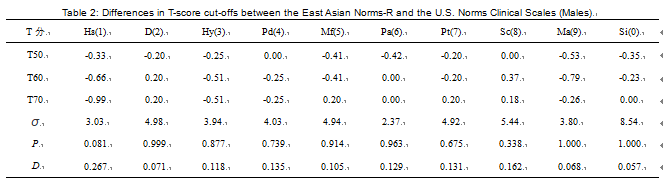
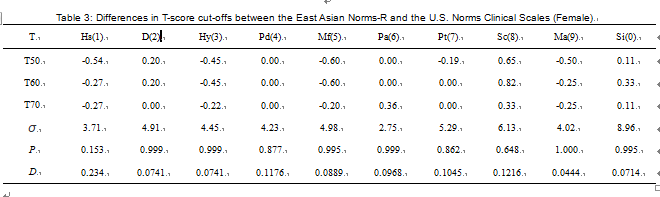
Differences in the concordance T-scores of the clinical scales between the East Asian Norms-R and the U.S. Norms are shown in Tables 2 and 3.
2.1.2 Validity scales
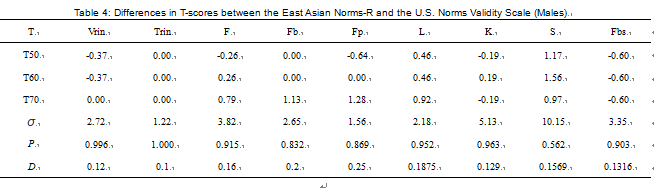
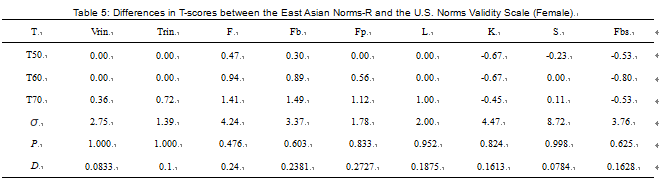
Differences in the concordance T-scores of the validity scales between the East Asian Norms-R and the U.S. Norms are shown in Tables 4 and 5.
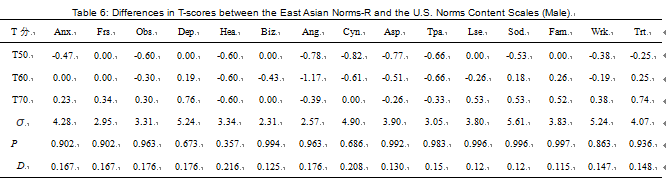
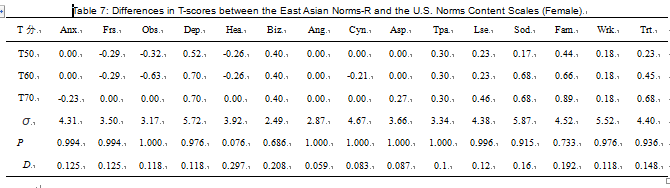
2.1.3 Content scales
The differences in T-scores for content scale consistency between the East Asian Norm-R version and the US norm are shown in Tables 6 and 7.
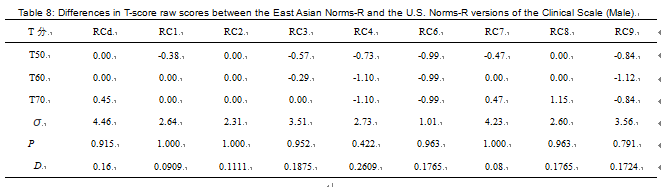
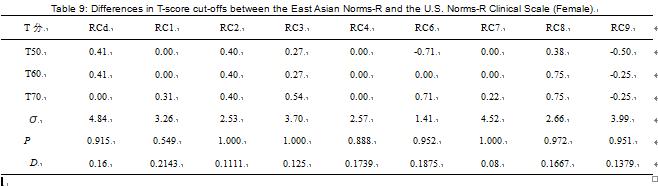
2.1.4 Reconstructed Clinical Scales
The differences in T-scores for content scale consistency between the East Asian Norm-R version and the US norm are shown in Tables 8 and 9.
2.2 Comparison of the Abnormal Group
For the abnormal group (males), both the East Asian Norm-R and U.S. Norm T-scores showed very significant differences from the normal T-score level (T60). As both versions use consistency T-scores for scoring, when the East Asian T-score is 70 or higher, the T-scores on key scales differ from the US T-scores by no more than one standard deviation.
2.2.1 Clinical scales
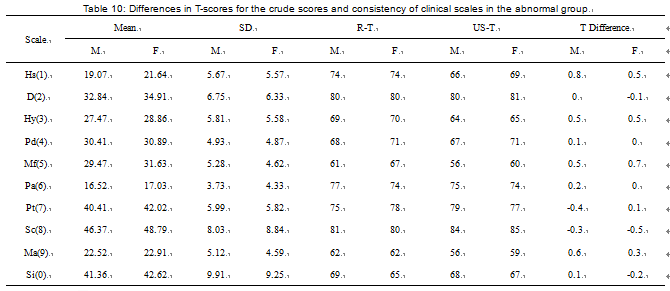
Differences in the mean, standard deviation and T-scores of clinical scales between the East Asian Norm-R and the US Norm for the abnormal group are shown in Table 10.
2.2.2 Reconstructed Clinical Scales
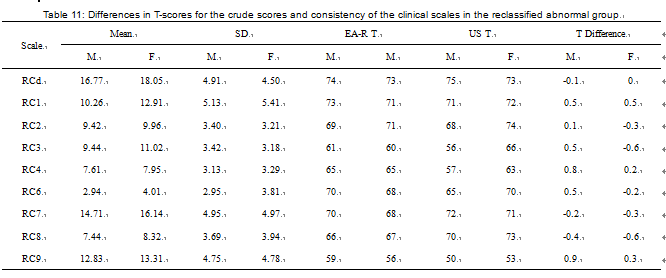
Differences in the mean, standard deviation and T-scores of the reconstructed clinical scales between the East Asian Norm-R and the U.S. Norm for the abnormal group are shown in Table 11.
2.2.3 MMPI-2 Key Items
The East Asian Norm-R version uses consistency T-scores for the ‘MMPI-2-Koss-Butcher Key Items’ and ‘MMPI-2-Lachar-Wrobel Key Items’; however, this requires further data validation as the positive cutoff remains set at T60.
The Koss-Butcher key items include six scales: Kb1 Acute Anxiety, Kb2 Depressive and Suicidal Ideation, Kb3 Threatening Aggression, Kb4 Situational Stress Due to Alcohol Abuse, Kb5 Mental Confusion and Kb6 Persecutory Ideas.
The Lachar-Wrobel Key Items include 11 scales: LW1 Anxiety and Tension; LW2 Depression and Worry; LW3 Sleep Disorders; LW4 Abnormal Beliefs; LW5 Abnormal Thinking and Experiences; LW7 Antisocial Attitudes; LW8 Family Conflict; LW9 Anger Problems; LW10 Sexual Concerns and Deviations; and LW11 Somatic Symptoms.
3. Discussion
The data indicate that, when comparing the East Asian Norms-R version with the US norms, the validity of positive screening results for East Asian populations is very similar. The differences merely reflect the actual data resulting from variations in participants’ social values and environments.
3.1 Discussion of Differences in Key Scales
3.1 Discussion of differences in key scales
3.1.1 Key scales (males)
The difference in positive T-scores for male Hy(1) was -0.66, indicating that East Asian men are more sensitive to their own health, while Western men are more concerned with symptom severity.
The difference in positive T-scores for male Hy(3) was -0.51, indicating that men in East Asian cultures express emotions more implicitly and tend to reveal psychological distress indirectly. In contrast, Western cultures encourage direct expression, making men more likely to release emotions directly.
The positive T-score difference for Mf(5) among men is -0.41, indicating that traditional gender roles are emphasised in East Asian cultures, leading men to behave more traditionally due to social constraints; in contrast, Western cultures are more diverse and accept masculine traits more readily.
The positive T-score difference for Sc(8) among men is 0.37, indicating that men in East Asian cultures tend to internalise psychological distress and respond more cautiously in the test due to the stigma surrounding illness. In contrast, Western cultures are more open and have lower stigma, leading men to express themselves more directly.
The positive T-score difference for Ma(0) among men is -0.79. Unlike Western cultures, East Asian cultures exhibit significant differences in men’s emotional expression. East Asian cultures are more reserved and hypomanic symptoms are more pronounced under stress. American culture emphasises individuality and is more tolerant of hypomanic symptoms.
3.1.2 Key Scales (Women)
The positive T-score difference for women on the Hy(3) scale was -0.45. This indicates that East Asian women are more reserved and have restricted emotional expression. They are also prone to converting emotional distress into somatic symptoms. In contrast, Western women express themselves more directly and their scale scores reflect their true emotional state.
The positive T-score difference for Mf(5) among women was -0.60, indicating that East Asian women face stronger societal expectations to be ‘good wives and mothers’ and are reluctant to display traits that deviate from tradition, whereas Western women are more free in their self-expression.
The positive T-score difference for the Sc(8) scale was 0.82, indicating that East Asian culture emphasises collective harmony and social evaluation. East Asian women may be more concerned about others’ opinions, which makes it difficult for them to reveal internal stress and underlying psychological distress. However, these issues may manifest more readily in specific situations on the SC scale. Western culture places greater emphasis on personal expression and self-actualisation, meaning that Western women are more likely to express their psychological distress directly.
The positive T-score difference for Si(0) among women is 0.82, indicating that East Asian women tend to internalise stress and are constrained by traditional notions, whereas Western women are more open about expressing their emotions.
3.2 Practical validation
The East Asian Norms-R Version (Comparative Edition) still requires validation in terms of its practicality and effectiveness in clinical, forensic and occupational selection settings. Additionally, the discriminatory power of the sample needs to be expanded further (e.g. to include different subpopulations). The ultimate goal is to strike a balance between the ‘scientific rigour’ and ‘practicality’ of the norms, ensuring they meet psychometric standards while also addressing the actual needs of the East Asian population.
Sample MMPI-2 Interpretive Report